

Key takeaways
- Margin is not markup. Margin divides profit by selling price; markup divides profit by cost.
- Credits are only one cost. Processing, support and refund exposure can materially change the result.
- Use contribution profit for pricing. It shows how much each customer contributes toward fixed costs and net profit.
- Annual plans are not automatically more profitable. Discounts, longer support obligations and refund risk must be included.
- Operate lawfully. Sell only services and content you are authorized to distribute, and make truthful pricing claims.
What is an IPTV reseller profit margin?
For an authorized IPTV reseller, profit margin is a ratio that connects selling price with the costs of delivering the service. The word “profit” is often used loosely, so separate these measures before making pricing decisions:
| Measure | Meaning | Best use |
|---|---|---|
| Revenue | Total money collected before costs | Sales tracking |
| Gross profit | Revenue minus direct service cost | Basic offer comparison |
| Contribution profit | Price minus all variable costs for one customer | Pricing and break-even |
| Net profit | Revenue minus variable and fixed business costs | Overall business health |
| Markup | Profit divided by cost | Cost-plus pricing |
| Margin | Profit divided by selling price | Comparing profitability |
Example: a hypothetical €20 sale with €8 in variable costs produces €12 contribution profit and a 60% contribution margin. That €12 still needs to cover monthly software, marketing, accounting, taxes and other fixed obligations before it becomes net profit.
If you are still setting up the business, begin with our guide on how to become an IPTV reseller, then return here with your real operating assumptions.
Calculate the real cost per customer
A credible pricing model uses costs you can document. Do not estimate from account balance alone. Create a simple cost sheet and update it whenever supplier pricing, payment fees or support workload changes.
1. Credit cost
Your actual credit consumption depends on the product and term configured in your panel. Never assume that every package consumes one credit. Check the real deduction recorded for the line you create or renew. Current Strong 8K credit tiers show decreasing unit cost at larger quantities—for example, 120 credits at €180 (€1.50 each), 600 at €850 (about €1.42 each), and 1,200 at €1,650 (about €1.38 each). Verify the live offer and conditions before purchasing.
2. Payment-processing cost
Use the rate from your own processor agreement and country. Published fees can differ by payment method, currency, customer location and dispute outcome. Stripe's official pricing page is a useful example of how providers itemize charges, but it is not a universal rate card.
3. Support time
Your time is a real economic cost. Include onboarding, troubleshooting, payment follow-up and renewal support. A reseller who ignores support time can appear profitable while creating an unsustainable workload. A well-organized customer line management workflow helps reduce avoidable handling time.
4. Refund and chargeback allowance
Historical data is best. Divide refunds, disputes and unrecovered transaction costs by completed sales over a meaningful period. Use that average as an allowance in future pricing, while keeping enough cash available for unusual months.
5. Fixed overhead
Domain renewal, business registration, accounting, compliance, software, advertising and administration are usually fixed or semi-fixed. Do not assign all of them to a single sale; use them in the break-even calculation below.
IPTV reseller profit calculator
Use this calculator to test a single package. The default values are hypothetical examples, not earnings estimates or guarantees. Replace every field with your verified figures.
Contribution margin and break-even calculator
How to set a sustainable reseller price
Establish your price floor
Your floor is the lowest price that covers variable cost and contributes enough toward overhead. Price below it only when you can identify a specific, measured reason—such as a limited acquisition test—and a clear end date.
Work backward from a target contribution
If variable costs are €8 and you want €12 contribution per sale, the pre-tax price needs to be at least €20. Recalculate after applying discounts. Subscription businesses commonly test flat-rate, tiered and usage-linked pricing; Stripe's subscription pricing model guide explains the trade-offs without prescribing one universal model.
Show the total price clearly
Customers should understand what they will pay, what term they receive and any renewal conditions. For customers in the European Union, official guidance says the displayed price should include taxes and compulsory charges where applicable. Review the EU pricing and payment rules and obtain local professional advice for your market.
Avoid unsupported performance or income claims
Do not promise guaranteed uptime, income or savings unless you have reliable evidence and the claim is accurate in context. The FTC advertising guidance is a useful standard: marketing claims should be truthful, non-deceptive and evidence-based.
Monthly, quarterly or annual packages?
| Term | Potential advantage | Cost to model |
|---|---|---|
| Monthly | Lower entry price and faster feedback | More frequent payment fees and renewals |
| Quarterly | Balanced cash flow and retention | Moderate discount and support obligation |
| Annual | Upfront cash and fewer renewal transactions | Larger discount, longer service commitment and refund exposure |
Compare terms by total contribution, not by headline revenue. A €120 annual sale may collect more cash upfront than a monthly sale, yet a deep discount plus a year of support can reduce its margin. Create separate calculator rows for each term and use the credit consumption that your panel actually records.
Why renewals can improve profitability
Renewals may require less acquisition and onboarding work than first-time sales, but they are not cost-free. Include payment fees, service credits, proactive support and reactivation time. Use a documented renewal process and confirm the correct line before extending it. Our panel dashboard overview explains the operational view, while your own records should remain the source of truth for costs.
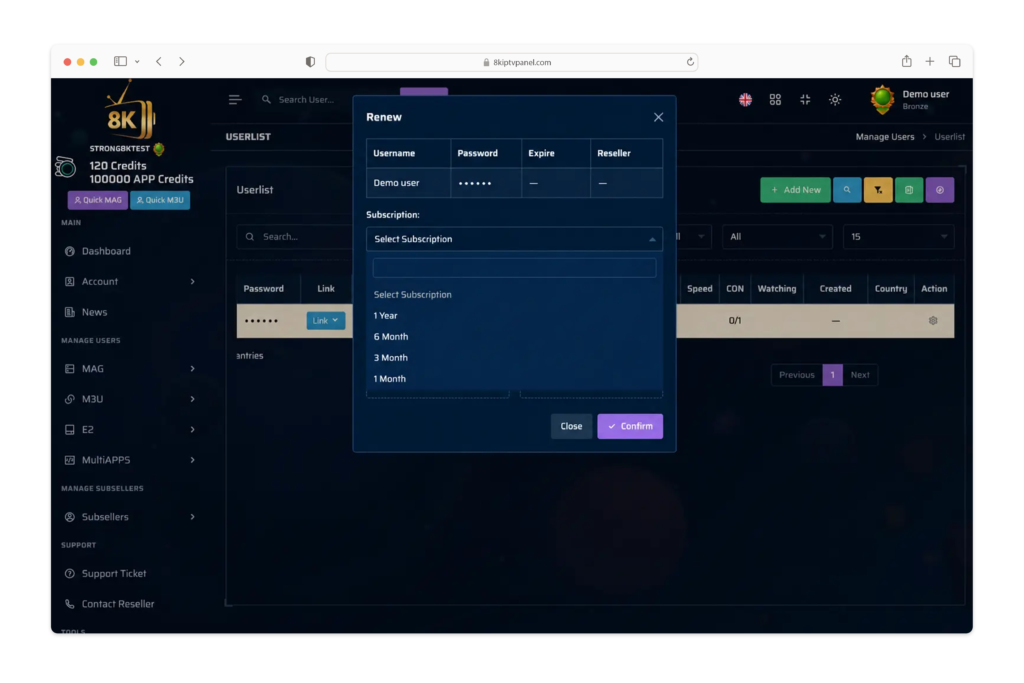
A practical renewal KPI is contribution profit after support time. If repeat customers need extensive recurring assistance, improve onboarding documentation rather than assuming retention alone will protect the margin.
Calculate the break-even point
If fixed costs are €300 per month and average contribution is €12, you need 25 comparable sales or renewals to cover those fixed costs. The U.S. Small Business Administration includes startup-cost and break-even planning in its official business planning resources. Adjust the method for local taxes and your business structure.
Protect margin with lawful operations
Pricing cannot compensate for missing distribution rights. Resell only services and content that you are expressly authorized to offer in the relevant territory. Keep supplier agreements, invoices, scope of rights, brand permissions and customer terms organized. WIPO explains that intellectual-property licensing defines how another party may use protected rights; its assignment and licensing guidance is a useful starting point.
Review our content rights and acceptable use policy. This article is business education, not legal or tax advice; consult qualified local professionals for obligations that apply to you.
Common margin mistakes
- Treating account balance as profit: unused credits are inventory or prepaid capacity, not cash profit.
- Copying a competitor's price: their credit cost, support load, taxes and risk may be different.
- Forgetting payment friction: fixed transaction fees hit low-priced packages harder.
- Pricing your time at zero: this hides the cost of manual onboarding and troubleshooting.
- Using one margin for every term: monthly and annual packages consume costs at different times.
- Ignoring churn and disputes: a small allowance based on real history is better than none.
- Buying credits before testing demand: larger packages can reduce unit cost but increase committed cash.
- Making promises you cannot verify: inaccurate marketing creates support, refund and compliance risk.
Metrics to review every month
- Average selling price by package and term
- Average credits consumed per activated or renewed line
- Payment fees as a percentage of revenue
- Support minutes per new customer and renewal
- Refund and dispute rate
- Contribution profit per sale
- Renewal rate and customer acquisition cost
- Fixed overhead and break-even sales volume
Record the numbers consistently. The goal is not a perfect spreadsheet; it is a repeatable decision process. When the assumptions change, the price decision should change too.
Frequently asked questions
What is a good IPTV reseller profit margin?
There is no universal percentage. A sustainable margin must cover your verified variable costs, contribute toward fixed costs, compensate your work and remain competitive. Compare your own packages over time rather than relying on an unsupported industry benchmark.
How do I calculate profit per IPTV customer?
Subtract credit cost, payment fees, support cost, refunds or disputes, and any other per-customer expense from the amount collected. The result is contribution profit before fixed overhead and taxes.
Is markup the same as profit margin?
No. Markup divides profit by cost, while margin divides profit by selling price. A product costing €10 and selling for €15 has a 50% markup but a 33.3% gross margin.
Should annual subscriptions always be cheaper?
No. A discount can encourage longer commitments, but it must be tested against credit consumption, support obligations, payment timing, refunds and the value of cash collected upfront.
How many customers do I need to break even?
Divide monthly fixed costs by the average contribution profit per customer. If the contribution is zero or negative, additional sales will not cover fixed costs under those assumptions.
Can I use the calculator as an earnings forecast?
No. It is a scenario tool. It does not predict demand, churn, taxes, disputes, exchange-rate changes or future supplier pricing.
Price the business before buying credits
Calculate your verified costs first, then compare the current Strong 8K credit packages and choose a starting quantity that fits your lawful reseller operation and cash flow.